

Perception usually lags reality.
Case-in-point. Recently a survey by HSBC caused quite a stir in the media when it reported that Singapore is the second most-expensive city for foreign undergraduates. This survey led some to conclude that Singapore’s losing its allure as an education hub.
Also, in response to the survey, some analysts have suggested rising rents around universities are a contributing factor to this high cost.
Renters, landlords, real estate agents, property investors, and university undergraduates can take two lessons from this case.
First, make sure you validate the sources that you’re using to make Singapore property decisions.
In this case, be careful what conclusions you draw from the HSBC survey. For example, the cost-of-living in the HSBC survey jumped from US$ 9,363 to US$ 20,292 in one year.
The reason for this dramatic difference appears to be that HSBC changed its source for measuring cost-of-living. This year, it relied on information from the expatriate portal Expatistan; whereas, the year before, HSBC sourced cost data from the Higher Education Statistics Agency (HESA).
Setting aside young scions of royalty and industrialists, foreign undergraduate students don’t live in luxury homes and eat at high-end restaurants typically frequented by expatriates. Most students live several persons to a flat and subsist on cup noodles.
As such, it’s dubious to apply expatriate cost-of-living to that of foreign students.
The second lesson is that public perception (and surveys) may not reflect the current situation.
It’s true that rents have increased near the universities. But over what period and, more importantly, what are the latest trends?
In order to answer these questions and properly assess the situation, you need access to timely, relevant, and accurate information.
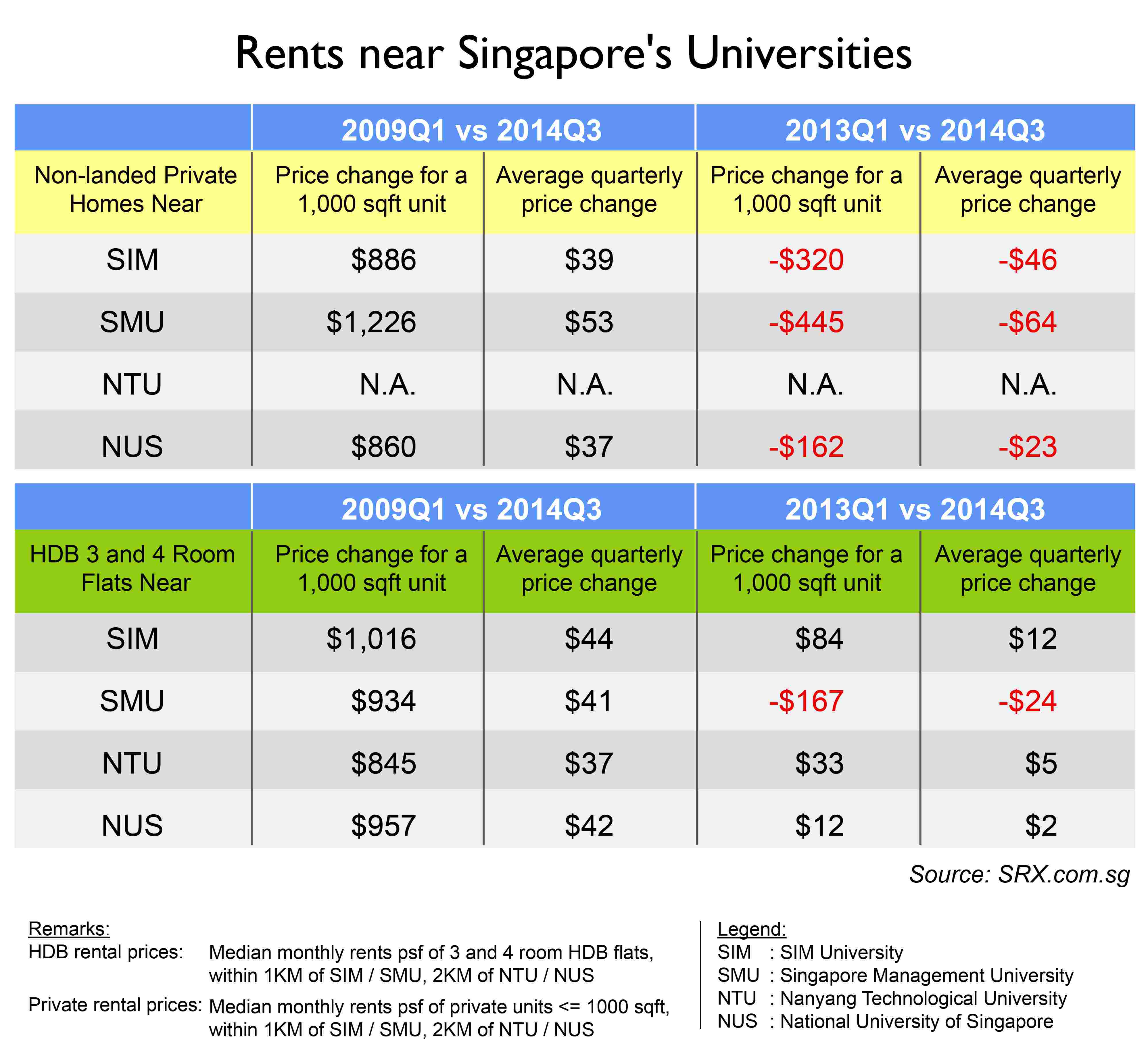
According to SRX Property, rent around the universities has increased since the Global Financial Crisis (GFC). However, there are several critical caveats that landlords, real estate agents, and foreign undergraduates should take into consideration.
- Median private rent around the four major universities has declined since the first quarter of 2013. For example, if you attend SMU and live in a nearby 1,000 square foot flat, median rent is cheaper by $ 445 per month or $5,340 per year;
- In the case of SIM and SMU, the rate of decline per quarter is greater than the increase in rent since the GFC. For example, if you attend SIM, median rent has dropped an average of $46 per quarter since first quarter 2013. In contrast, during the build-up in rent, the average quarterly rate was $39;
- In the case of HDB’s near SMU, monthly median rent has declined by $167 while the other three universities have seen increases ranging from $12 to $84.
The trend in rentals around the universities is clear. Private rent has been coming down as more supply comes on the market and renters look for less expensive alternatives, like HDBs.
Furthermore, the $84 monthly increase in rent for an HDB unit that two SIM students are splitting is certainly not responsible for the $10,929 increase in cost-of-living reported by HSBC.
So, here’s my advice to foreign undergraduates who want to live near a Singapore university.
Stick to the noise coming from your headphones rather than the noise coming from the market.
For more details on the data used for this article, please visit SRX Research.