

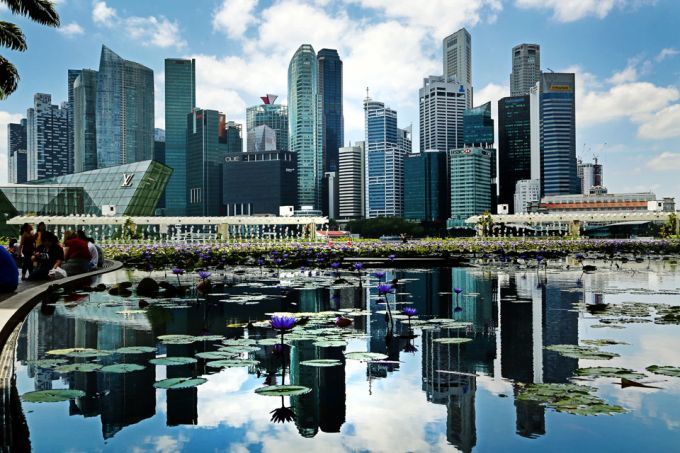
LAST week, the announcement of Singapore's Draft Master Plan 2019 cast the spotlight on the Central Area.
The blueprint is the Singapore government's effort to ensure that the work, live and play concept fully takes root, to enhance Singapore's status as a talent hub in the region, or even globally. The plans for the Central Business District (CBD) present tremendous opportunities for placemaking, curating experiences around working, living and playing in the CBD.
The people-centric approach is in step with the ever-changing lifestyle needs of the millennial generation.
The idea is not new as the vision of a vibrant 24/7 Marina Bay was first unveiled more than a decade ago. But the earlier efforts did not yield the desired outcome.
Today, apartments in the CBD remain more accessible to affluent and high net worth individuals, because property prices there are beyond the reach of the less wealthy. Local families shun this neighbourhood, due to the lack of amenities, childcare and school options for young children. The target pool of residents remains mostly expatriates, singles and DINKS (dual income no-kids couples).
The traditional CBD has also not kept pace with a new breed of young urbanites looking for a new lifestyle. Commercial buildings particularly in Cecil Street, Shenton Way/Tanjong Pagar and Anson areas are largely isolated. The average building age is around 24 years and only a handful have undergone redevelopment.
The Urban Redevelopment Authority's Draft Master Plan 2019 is trying to steer away from this perception by introducing the CBD Incentive Scheme, which encourages the conversion of older office buildings into mixed-use projects such as residential and hotel to attract a larger pool of residents and transient populations such as business travellers and leisure tourists. By granting commercial landlords bonus plot ratio increases of 25-30 per cent, together with a potential lease top-up for entire mixed-use developments, the scheme opens up many permutations for redevelopment for commercial landlords.
Private owners can also take advantage of this to divest older assets to developers and operators who have the expertise in mixed-use developments. Thus, we can expect a wave of redevelopment over the next 10-20 years.
City living
Apart from the CBD, the authority also said that more homes will be introduced in city locations such as Orchard, Pearl's Hill, Marina Bay and Marina South, offering residents a greater variety of city living options, with easy access to transport and employment nodes, lifestyle and recreational choices.
Such moves are headed in the right direction if Singapore were to truly become a liveable global city.
London stands out as the most coveted place to live in the world. It is a hub for everything from entertainment, business and education to multiculturalism. Central London is also home to some of the world's top universities and high-quality educational institutions attracting about 103,000 international students living and learning in the city. It is the people who make London great.
Turning to Singapore's CBD, can we make the CBD more inclusive to the masses so that it will evolve into a business and residential community? One way to make it happen is to extensively adopt co-living concepts in the city centre, so that the average Singaporean could also have the opportunity to live closer to their workplace.
We can also consider allowing training facilities, fintech firms or wealth management campuses to be included in the mixed-use developments. This would present even greater opportunities for people movement in and out of the city centre, through more student exchange and internship programmes.
Residential developers and hotel operators should be allowed to explore innovative ways to inject life into the residential and hotel developments with few boundaries. As long as the objectives of optimising CBD land and bringing life back to the city centre after office hours are met, rules such as having no more than six unrelated people in a tenanted unit should be relaxed so as to increase the attractiveness of city living, making this transformational journey for the CBD most meaningful.
- Christine Li is senior director, head of research at Cushman & Wakefield, Singapore